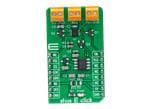

MIKROE-4630

Mikroe
932-MIKROE-4630
MIKROE-4630

Mfr.:

Description:
Power Management IC Development Tools eFuse 3 Click

In Stock: 4

Stock:
4 Can Dispatch Immediately
Minimum: 1   Multiples: 1
Unit Price:
-,-- €
Ext. Price:
-,-- €
Est. Tariff:

Pricing (EUR)

Qty. Unit Price
Ext. Price
21,50 € 21,50 €

Product Attribute Attribute Value Select Attribute
Mikroe
Product Category: Power Management IC Development Tools
RoHS:  
Add-On Boards
eFuse
3.3 V to 5 V
6.1 V
NIS6150
Brand: Mikroe
Dimensions: 42.9 mm x 25.4 mm
Interface Type: SPI
Maximum Operating Temperature: + 150 C
Minimum Operating Temperature: - 40 C
Product Type: Power Management IC Development Tools
Factory Pack Quantity: 1
Subcategory: Development Tools
Products found:
To show similar products, select at least one checkbox
Select at least one checkbox above to show similar products in this category.
Attributes selected: 0

TARIC:
8473302000
USHTS:
8536308000
JPHTS:
853630000
KRHTS:
8536300000
ECCN:
EAR99

Click Boards™

MikroElektronika MikroBUS™ Adapter click boards™ are designed to revolutionize the way users add new functionality to development boards. The user can push a click board into the innovative new MikroBUS™ standard socket and use it with zero hardware configuration. Categories of MikroElektronika mikroBUS™ Adapter click boards include Wireless Communication Modules, Wired Communication Modules, Sensor Modules, and Miscellaneous Modules & Accessories.

Power Management Click Boards

Mikroe Power Management Click Boards are used to add power management solutions for various applications. Mikroe Click Boards are based around the mikroBUS™ interface standard and easily add incredible system capabilities. The devices are ideal for any type of power applications, including medical, industrial, and automation.

eFuse 3 Click

Mikroe eFuse 3 Click features the ON Semiconductor NIS6150 resettable fuse that can significantly enhance the reliability of a USB application from both catastrophic and shutdown failures. It's designed to buffer the load device from the excessive input voltage, which can damage sensitive circuits and protect the input side from reverse currents. It includes an over-voltage clamp circuit that limits the output voltage during transients but doesn’t shut the unit down. This allows the load circuit to continue its operation.