



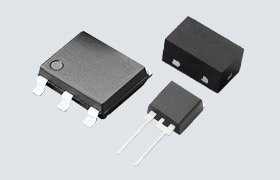



KEMET KPS L Series SnPb Termination X7R SMD MLCCs
KEMET KPS L Series SnPb Termination X7R SMD MLCCs utilize a proprietary lead-frame technology to vertically stack one or two MLCCs into a single compact SMD package. The attached lead frame mechanically isolates the capacitors from the printed circuit board. This offers advanced mechanical and thermal stress performance. Audible, microphonic noise that may occur when a bias voltage is applied is addressed through isolation. A two-chip stack offers up to twice the capacitance in the same or smaller design footprint when compared to traditional surface-mount MLCC devices. Applications for KEMET KPS L Series SnPb Termination X7R SMD MLCCs include switch-mode power supplies, high-voltage coupling and DC blocking, lighting ballasts, voltage multiplier circuits, smoothing circuits, and much more.
Features
- -55°C to +125°C operating temperature range
- Reliable and robust termination system
- EIA 1210 and 2220 case sizes
- 10V, 16V, 25V, 50V, 100V, 250V, 500V and 630V DC voltage ratings
- 0.047μF up to 47μF capacitance range
- ±10% and ±20% capacitance tolerance
- Higher capacitance in the same footprint
- Potential board space savings
- Advanced protection against thermal and mechanical stress
- Provides up to 10mm of board flex capability
- Reduces audible, microphonic noise
- Low ESR and ESL
- SnPb-plated termination finish (5% Pb minimum)
- Non-polar device, minimizing installation concerns
- Tantalum and electrolytic alternative
Applications
- Switch-mode power supplies (input filters, resonators, tank circuits, snubber circuits, output filters)
- High-voltage coupling and DC blocking
- Lighting ballasts
- Voltage multiplier circuits
- DC/DC converters and coupling capacitors in Ćuk converters
- Smoothing circuits
- Noise reduction (piezoelectric/mechanical)
- Circuits with a direct battery or power source connection
- Critical and safety-relevant circuits without (integrated) current limitation
- Any application that is subject to high levels of board flexure or temperature cycling
Related Capacitors

KEMET High Voltage C0G MLCCs (Commercial & Auto Grade)
≥500V with capacitance values up to 150nF and case sizes ranging from EIA 0603 to 4540.

KEMET High Voltage X7R Dielectric SMD MLCCs
Features a voltage range of 500VDC to 3000VDC with a +125°C maximum operating temperature.
KEMET ArcShield™ High Voltage Surface Mount Capacitors
Prohibits arc-over, significantly reducing resulting failures.
Published: 2016-09-16
| Updated: 2023-08-23