



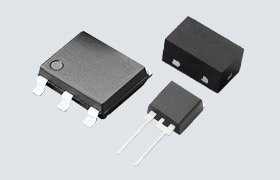



ams OSRAM Vital Sign Monitoring Applications

With the new generation of sensors and algorithms, device manufacturers can now take health monitoring to a new level. These advances are based on special semiconductor sensors and signal processors, tiny chips that perform complex optical or electrical operations. While the implementation of vital signs monitoring at chip scale is new, the principles of the techniques that these chips use to measure vital signs are well established and understood.
Photoplethysmography (PPG) is an optical technology. Light is projected into the body, passing through the skin to reach an artery. A photodiode (light sensor) measures the light reflected from or passing through the blood vessels. When the heart pulses, the artery is forced to expand and fill with blood, absorbing more light. The photodiode detects the periodic rise and fall in reflected/transmitted light levels. This optical signal can be converted into a measurement of heart rate and heart rate variability. Very sensitive and accurate optical systems can also use PPG signals to measure blood pressure. For heart rate measurements, wearable devices generally use a green light emitter.
The same principle measures blood oxygen saturation (SpO2) since oxygenated hemoglobin has a distinctly different light absorption pattern than unoxygenated hemoglobin. SpO2 systems use red and infrared (IR) emitters.
Electrocardiography (ECG) measures the pattern of electrical activity as the heart’s muscles contract and expand to pump blood around the body. This electrical sensing technique may monitor sleep patterns or detect abnormal or irregular heart activity.
Galvanic skin response measurement is another electrical sensing technique that tracks the activity of sweat glands. The outputs of galvanic skin response sensors may be used to monitor the user’s emotional state. Both ECG and galvanic skin response may be implemented with a combination of electrodes and signal-processing circuitry.
Videos
Block Diagram

Featured Products

ams OSRAM Chip LED™ SFH 2707 Broadband Photodiodes
Devices feature an improved active area-to-package ratio, delivering up to 24% higher photocurrent.

ams OSRAM CT ELLN51.14 Chip LED
High-performance, ultra-compact LED emitting true green light with a peak wavelength of 526nm.

ams OSRAM MULTILED® SFH 7018x for Vital Sign Monitoring
3-in-1 multi-emitters with a highly reflective QFN package for significantly greater light output.

ams OSRAM SFH 270xH Broadband Harsh Finish Photodiodes
Engineered with a durable surface finish that resists scratches and assembly-related wear.

ams OSRAM SFH27x3 PIN Photodiodes
Features small outline dimensions, suitable for reflow soldering, comes in a clear epoxy package.

ams OSRAM SFH 2704 CHIPLED® Silicon PIN Photodiode
Designed for use in health monitoring applications like heart rate monitoring and pulse oximetry.
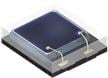
ams OSRAM SFH 2,704 A Silicon PIN Photodiode
Ideal for use in health monitoring applications, including smartwatches for vital data monitoring.

ams OSRAM SFH 2705 & SFH 2706 Silicon PIN Photodiodes
Designed for use in health monitoring applications like heart rate monitoring and pulse oximetry.

ams OSRAM AS7058 Integrated Analog Front Ends
Multi-vital sign monitoring devices that provide complete PPG, ECG, BioZ, and EDA.

ams OSRAM AS7056 & AS7057 Medical & Health Sensors
Next-generation Analog Frontend (AFE) vital sign sensors in a Small Wafer-Level-Chip-Scale-Package.

ams OSRAM AS6221 & AS6221T Digital Temperature Sensors
Consists of a Si bandgap temperature sensor, an ADC and a digital signal processor.

ams OSRAM AS6223 Digital Temperature Sensors
A high-accuracy sensor system that communicates through a two-wire digital bus with other devices.

Learn More About

ams OSRAM Medical Imaging
Offer outstanding precision, high acquisition speeds, low noise, and ultra-low power consumption.