



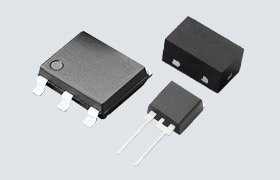



Toshiba DTMOSIV-H MOSFETs
Toshiba DTMOSIV-H MOSFETs are suited to applications that require high reliability, power efficiency, and a compact design, such as high-efficiency switching power supplies for servers and telecom base stations and as power conditioners for photovoltaic inverters. Toshiba DTMOSIV-H MOSFETs achieve a high-speed switching performance while keeping the low ON-resistance level of conventional DTMOSIV and without loss of power. This is accomplished by reducing parasitic capacitance between gate and drain, which also contributes to improved power efficiency and downsizing of products.
Features
- Gate pattern optimization, resulting in a 45% reduction in gate-drain charge when compared with conventional DTMOSIV
- A small increase in low ON-resistance at high temperatures due to the use of the single epitaxial process
- Low ON-resistance lineup
- 1 channel
- N-channel transistor polarity
- 10V gate drive
- 600V drain-source breakdown voltage
- 7.7A to 61.8A continuous drain current
- 0.04Ω to 0.135Ω RDS(ON) maximum
- DFN, TO-220, TO-220SIS, and TO-247 package options
Application Notes
- Bipolar Transistors: Electrical Characteristics
- Bipolar Transistors: Maximum Ratings
- Bipolar Transistors: Terms
- Bipolar Transistors: Thermal Stability and Design
- Calculating the Temperature of Discrete Semiconductor Devices
- Derating of the MOSFET Safe Operating Area
- Hints and Tips for Thermal Design for Discrete Semiconductor Devices: Part 1
- Hints and Tips for Thermal Design for Discrete Semiconductor Devices: Part 2
- Hints and Tips for Thermal Design for Discrete Semiconductor Devices: Part 3
- IGBTs (Insulated Gate Bipolar Transistors)
- Impacts of the dv/dt Rate on MOSFETs
- MOSFET Avalanche Ruggedness
- MOSFET Gate Drive Circuit
- MOSFET Paralleling (Parasitic Oscillation between Parallel Power MOSFETs)
- MOSFET Self-Turn-On Phenomenon
- Parasitic Oscillation and Ringing of Power MOSFETs
- Power MOSFETs: Maximum Ratings
Published: 2019-10-01
| Updated: 2023-12-08