



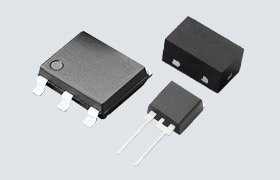



Texas Instruments ISO1050 Isolated CAN Transceivers
Texas Instruments ISO1050 Isolated CAN Transceivers are galvanically isolated devices that meet the specifications of the ISO11898-2 standard. These transceivers have logic input and output buffers separated by a silicon oxide (SiO2) insulation barrier that provides galvanic isolation of up to 5000VRMS for ISO1050DW and 2500VRMS for ISO1050DUB. When used with isolated power supplies, the devices prevent noise currents on a data bus or other circuits from entering the local ground and interfering with or damaging sensitive circuitry. TI ISO1050 Isolated CAN Transceivers provide differential transmit capability to the bus and differential receive capability to a CAN controller at signaling rates up to 1Mbps. The series is characterized for operation over an ambient temperature range of -55°C to +105°C and is ideal for use in industrial automation, control, sensors, and drive systems.
Features
- Meets requirements of ISO11898-2
- Isolation
- 5000VRMS (ISO1050DW)
- 2500VRMS (ISO1050DUB)
- Low loop delay
- 150ns (typical)
- 210ns (maximum)
- Fail-safe outputs
- 50kV/μs typical transient immunity
- –27V to 40V bus-fault protection
- Driver (TXD) dominant time-out function
- I/O voltage range supports 3.3V and 5V microprocessors
- Numerous safety-related certifications
Applications
- CAN bus standards
- CANopen
- CANaerospace
- DeviceNet
- NMEA2000
- ARINC825
- ISO11783
- CanKingdom
- Industrial automation, control, sensors, and drive systems
- Building and climate control (HVAC)
- Security systems
- Transportation
- Medical
- Telecom
Block Diagram

Evaluation Tools

Texas Instruments F28379D controlCARD for C2000 Real Time Dev Kits
Position manager-ready and an ideal product for initial software development.
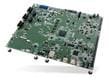
Texas Instruments EVMK2GX/EVMK2GXS 1GHz Evaluation Module (EVM)
Enables developers to immediately start evaluating the 66AK2Gx processor family.

Texas Instruments ISO1050EVM Evaluation Module (EVM)
Designed for the evaluation of the ISO1050 isolated CAN transceiver.
TI Reference Design Library

Published: 2013-08-30
| Updated: 2024-08-01