Harsh Environments Challenge Power Management
By Lynnette Reese, Mouser Electronics
The possibility of extreme cost savings that data-based predictive modeling brings to the industrial world of
system monitoring and control will further the automation of factories
and manufacturing and assist in refurbishing transportation and energy transmission infrastructure. The need
for data will require carpeting the industrial world with
high-resolution components connected to the Internet of Things (IoT). But in spite
of advances in industrial IoT, consideration for harsh environments still remains critical in the humble
form of enclosures and power management.
Entirely new business opportunities from the analysis of IoT-generated data can come from sensors and
controllers, especially in harsh environments (HE).
General Electric’s (GE) Jet Engine business, for example, has been dramatically transformed by the use of
predictive models. This new “digital industrialization” accesses, interprets, and analyzes terabytes of
performance data, transforming it into cost savings and greater productivity in part by modifying
maintenance and repair schedules. GE’s efforts don’t end with jet engines. GE will “reap $1 billion in added
productivity from its operations as more factory and design processes are fed into digital systems that
improve collaboration and speed up production cycles,” according to the Wall St. Journal.i
But GE has no monopoly on measuring the impact of harsh environments on electronic systems. The oil and gas
industry has long used “downhole” electronics,
connectors and devices that must withstand temperatures as high as 200°C (415°F) and pressures
as high as 30,000 pounds per square inch (PSI). Yet there are many other applications in which the electronics
must be protected from harsh environments
Protecting power rails is particularly challenging, in ensuring the integrity of electronic systems. Even if the
power supply is not operating at the
tip of an oil well drilling probe, industrial environments can be threatening to the longevity of electronics.
Power management devices must
provide precise control of voltages, even under horrendous current loads. These devices are the building blocks
for power supplies, pulse motor controls, and auto ignition systems.
Not surprisingly, market research firms have identified industrial controls as the primary market driver for
power management controllers (voltage regulators, motor drivers, pulse and spark generators) — displacing
computer power supplies as the primary consumer of power management chips and modules. Industrial and computing markets each consume about
$3.5 billion in power management semiconductors per year.
Compared to the parts used in computer and communications data centers, industrial power management devices must
operate at higher voltages (which increases the difficulty of waveform control, and challenges energy transfer
efficiency). Anything that interfaces with a three-phase 220VAC powerline, for example, must be rated for 600 volts or more. Chances are — despite the
demand for high energy transfer efficiency — large heat sinks will be required. The additional challenge for
industrial power control is an ability to maintain speed, precision, and efficiency in harsh environments.
The Challenge of Harsh Environments
Electronics that are designed to operate in harsh environments often surpass military specifications (i.e.,
-40°C to 125°C). Ruggedized enclosures must
protect electronic circuitry from exposure to liquids, particles and tampering. The two most relevant enclosure
specifications include the National Electrical Manufacturers Association (NEMA) ratings and the
almost-equivalent Ingress Particulate (IP) code (IEC 60529). These documents effectively quantify the degree to
which a product can withstand various harsh conditions (such as dust storms or emersion in corrosive liquids.)
NEMA enclosure standards actually specify the degree of protection the enclosure provides. Depending on which
document you consult, a NEMA Type 1 enclosure will either protect workers inside from falling dirt and stones,
or serve as a barrier to keep them from handling the electronic circuitry inside. The degree of protection, as
well the restriction of access, increases with NEMA ratings numbers. A Type 3 rating, on the other hand,
provides a degree of protection from the ingress of water (rain, sleet, snow) — or the formation of ice on the
outside of the enclosure. Cellular base stations, often sealed canisters mounted on telephone poles, reflect NEMA 4X ratings. Type 12 specifies enclosures
intended for use in dusty industrial applications with additional protection from non-corrosive liquid drips.
| 4 & 4X
|
GENERAL PURPOSE WEATHER-PROOF |
Intended for use indoors or out doors with protection from wash down environment and corrosion
resistance. |
| 6 & 6P
|
GENERAL PURPOSE SUBMERSIBLE |
Intended for use indoors or outdoors with protection from occasional submersion. |
| 7 |
HAZARDOUS |
Intended for indoor use in Class I, Groups A, B, C, and D
environments per NFPA rating system. |
| 8 |
HAZARDOUS |
Intended for indoor or outdoor use in Class I, Groups A, B, C, and D
environments per NFPA rating system. |
| 9 |
HAZARDOUS |
Intended for indoor or outdoor use in Class II, Groups E, F, and G
environments per NFPA rating system. |
| 12 & 12K |
INDUSTRIAL |
Intended for use in industrial applications with protection from dust and non corrosive liquid drip.
|
| 13 |
INDUSTRIAL |
Intended for use in industrial applications with protection from dust, spraying water, oil and non
corrosive liquid drip. |
Table 1: Enclosures listed by NEMA Rating
The IP standards are a bit more explicit. The IP-68 environment, for
example, specifies “permanent emersion” in liquids as much as 3 meters deep, and a total seal against dust.
In addition to particle ingress, electronics can be easily damaged or rendered inoperable if exposed to water or
other liquids. Automotive engine compartments are especially vulnerable. Mounted in systems just under the hood
of a vehicle, electronic components are exposed to vibration, heat, humidity, water, mud and motor oil.
Protecting Your Power Rails: Examples to Consider

Figure 2: Mean Well's HEP-100 Series industrial-grade power
supplies resist 6KV surges, and can be potted for IP68 moisture resistance. Image: Mean Well.
While selecting an enclosure is necessary in protecting circuits from wet and dusty environments, don’t overlook
the reliability and service record of power sources. The Mean Well HEP-100 is an industrial
power supply intended for harsh environments and elevated temperatures (-55°C to +70°C). This is an
AC/DC power supply with up to 94% efficiency. Five versions are available, with 100-, 150-, 185-, 240-, or
320-watt outputs. The HEP supplies accept a wide input range (90 to 305VAC) and offer output voltages of 12V,
15V, 24V, 36V, 48V, or 54V, making the series scalable across many applications.
The 320-watt version offers enough power to run programmable logic
controllers in factory environments (or for server cards with high on-time duty cycles). The switching
supply includes short circuit, over voltage, and current overload protection. It resists current surges up to
6kV. These power supplies are potted with heat-conductive silicone and provide up to IP68 protection against the
ingress of dust and water (completely sealed) and up to 10G in vibration resistance. The series is suited for
outdoor telecommunication equipment, outdoor signage and billboards, and petroleum plants or mine shaft
facilities.
NXP Semiconductor’s SB0410 is
a different kind of power management device. The industrial motor controller on a chip is a quad valve and pump
controller system-on-chip (SoC). It includes four low-side regulated solenoid drivers and a high-side pulse
width modulator (PWM) to control a pulsed DC motor (with the aid of outboard MOSFET power transistors). The
device is protected from loads with high inrush currents. The pulsed motor drive circuits will deliver up to
2.25A (with 5.0 kHz pulses).
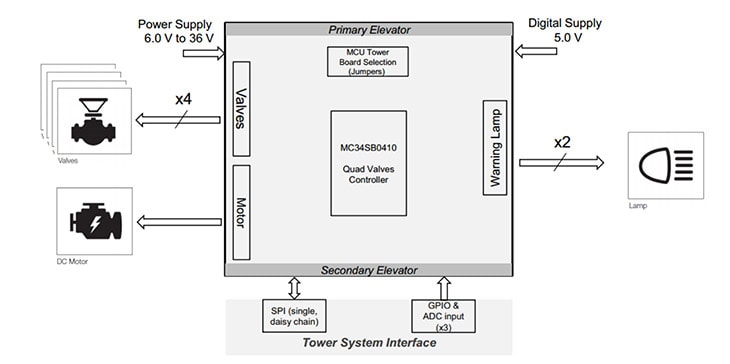
Figure 3: NXP Semiconductor’s
SB0410 is an industrial controller chip is a quad valve and motor drive system-on-chip (SoC). It
includes four low-side regulated solenoid drivers and a high-side pulse width modulator (PWM) for motor
drive. Image: NXP.
For harsh environments, the NXP SB0410 includes a die temperature warning. HE applications as identified by NXP
include spot welding, laser cutting, bottle molding, heavy equipment and construction machinery, and fork lifts.
Other applications include irrigation control systems.
Power management is always necessary for electronics in harsh environments, since all active electronics require
power. One very common example is the high operating temperatures and high vibration environment inherent in
automotive electronics. Infineon Technologies’
AEC-qualified TLF80511EJ LDO Linear
Regulator uses a conventional series pass topology, for load currents up to 400mA. Low operating
currents allow the parts to be permanently connected to a battery without overload. A low quiescent current
(38µA) for this device prevents battery drain. Thus, these otherwise conventional regulators are great for automotive instrument clusters.
Specifically intended for automotive
applications, the part operates from -40°C up to 150°C. Other automotive applications include
Electronic Control Units (ECU), automotive dashboards, climate in-cabin (HVAC), and start-stop engines.
Conclusion
Maintaining specified voltage levels under often severe current loads remains the on-going challenge for power
management devices. Voltage converters and regulators are additionally tasked with maintaining high energy
transfer efficiency to prevent heat generation. Harsh environments that demand controlled electronic system
performance in tightly-sealed enclosures only complicate requirements. Engineers must be careful to specify only
those components that are fully up to the task.
iTed Mann, “GE Bullish on Data for Big Industry,” Wall Street Journal,
23 June 2016. Web. 1 July 2016.
 Lynnette Reese is a
member of the technical staff at Mouser and holds a B.S. in Electrical Engineering from Louisiana State
University. Prior to Mouser, she completed a combined 15 years in technical marketing in embedded hardware and
software with Texas Instruments, Freescale, and Cypress Semiconductor. She started her career as an applications
engineer at Johnson Controls.
Lynnette Reese is a
member of the technical staff at Mouser and holds a B.S. in Electrical Engineering from Louisiana State
University. Prior to Mouser, she completed a combined 15 years in technical marketing in embedded hardware and
software with Texas Instruments, Freescale, and Cypress Semiconductor. She started her career as an applications
engineer at Johnson Controls.
 Slovakia